

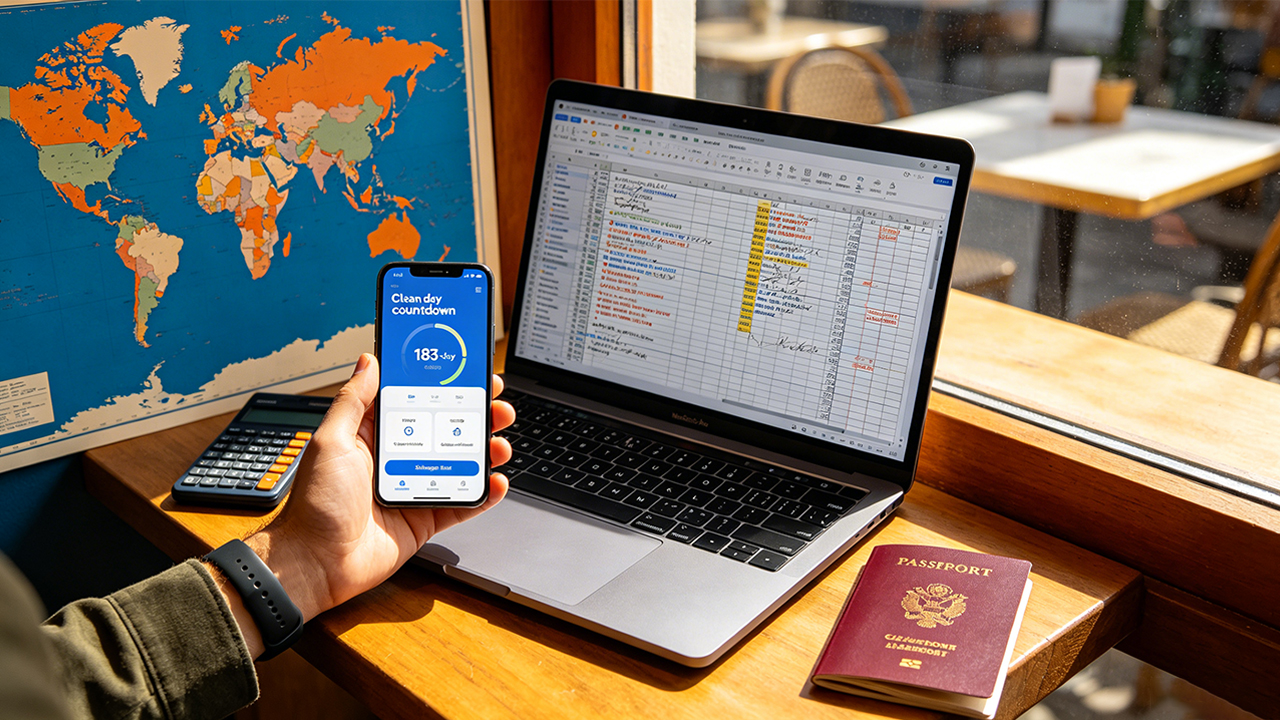
Picture digital nomads bouncing between cafés in Lisbon one month and coworking spaces in Chiang Mai the next, all while attempting to keep track of 183-day tax residency thresholds, Schengen 90/180 visa limits, and the IRS forms required each April. Recent research shows that dozens of countries now offer long-stay remote worker visas, but those opportunities increasingly come paired with strict tax, residency, and documentation requirements.
After testing more than a dozen apps across both iOS and Android, the evaluation centered on a straightforward question: does the app genuinely help digital nomads remain compliant without forcing them into endless spreadsheets? The five finalists below ultimately proved themselves strongest in real-world use.
Pricing:Free download with in-app purchases (subscription pricing typically around $5–$6 per month)
The reality check
Pebbles takes an unusual approach compared to most travel-tracking apps: it deliberately avoids GPS tracking, and that decision becomes one of its biggest strengths. While many competing platforms rely heavily on constant location permissions, Pebbles focuses instead on manual travel logging and straightforward compliance tracking.
During testing for Schengen 90/180 calculations, the manual-entry workflow proved surprisingly streamlined. Rather than continuously monitoring user location data, the app simply allows travelers to log entries and exits directly, creating a more privacy-conscious experience with minimal battery drain.
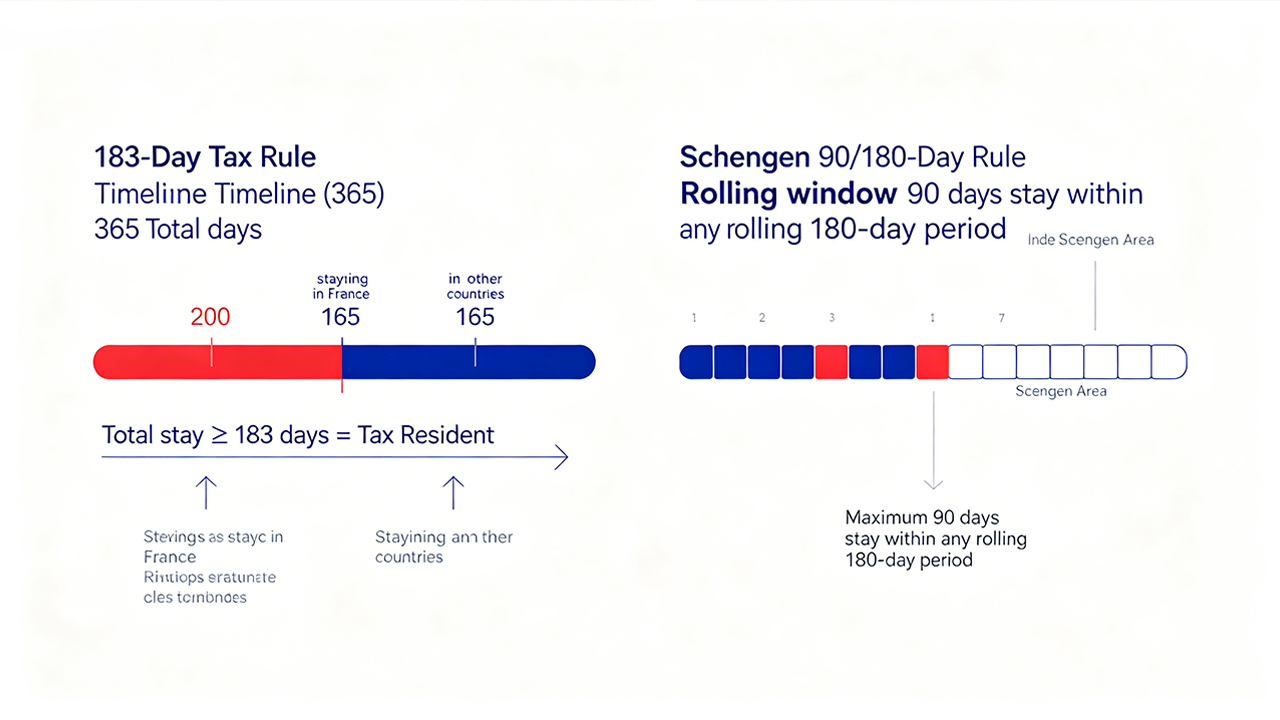
The platform centers around one of the most important compliance metrics for digital nomads: the 183-day rule. Since this threshold determines tax residency in many countries, Pebbles is designed specifically to help users monitor time spent across countries as well as individual U.S. states. In addition to tax residency calculations, the app also supports Schengen 90/180 tracking and broader visa deadline management.
Pros:
No GPS tracking reduces privacy concerns and minimizes battery usage
Supports tracking for both international jurisdictions and individual U.S. states
Clean, minimal interface with visual progress indicators for residency thresholds
Particularly well suited to digital nomads who prefer manual control over automated location collection
Cons:
Manual logging requires consistency and user discipline
Full functionality requires a paid subscription
Currently limited to iOS devices only
Final Call
Pebbles works best for privacy-focused digital nomads who prefer manually managing their travel records while maintaining accurate 183-day tax residency tracking across multiple jurisdictions.
Pricing:Free trial available, with subscription required for full feature access
The reality check
In May 2026, only days before testing for this review concluded, Flamingo Compliance released a major update introducing expanded Schengen Area trip-planning tools as Europe’s evolving digital border controls continued rolling out. The timing made the platform particularly relevant for digital nomads navigating the region’s increasingly strict entry-exit tracking systems.
During testing across three continents over a two-week period, Flamingo’s standout capability quickly became clear: highly customizable tax residency tracking. Users can create separate trackers for either achieving tax residency or actively avoiding it, depending on their financial and legal goals. The platform supports monitoring across countries, U.S. states, and even select U.S. cities—currently including New York City, with additional cities planned.
For Schengen compliance, Flamingo integrates a built-in 90/180-day calculator directly into the main dashboard. The tool continuously updates rolling-day totals and clearly indicates when re-entry into the Schengen Area becomes legally safe. The app’s Passport Index also synchronizes in real time with the IATA database, allowing visa requirements to remain current without requiring separate manual research.
One particularly impressive feature was the ability to add hypothetical future trips and immediately see projected residency outcomes before making bookings. During testing, a simulated itinerary involving a 90-day stay in Spain followed by travel to London triggered an instant warning about potential UK Statutory Residence Test implications—an issue that could easily have gone unnoticed without automated forecasting tools.
From a privacy perspective, Flamingo adopts a notably conservative approach. Travel history, residency calculations, and visa data remain stored locally on the user’s device and within iCloud rather than on company-controlled servers.
Pros:
Customizable trackers for both achieving and avoiding tax residency across countries, states, and cities
Integrated Schengen 90/180 calculator within the same dashboard
Real-time visa requirement lookups synchronized with IATA databases
Future-trip forecasting helps identify residency risks before booking travel
Clean CSV exports simplify sharing records with tax professionals and auditors
Privacy-focused architecture keeps user data stored locally rather than on developer servers
Cons:
U.S. city-level tracking currently remains limited primarily to New York City
Some users have reported confusion regarding subscription feature tiers after upgrades
Currently unavailable on Android devices
Final Call
Flamingo Compliance works best for digital nomads seeking a centralized platform for managing tax residency, Schengen compliance, visa research, and long-term travel planning simultaneously. Following its May 2026 update, it also stands out as one of the most current and Europe-focused compliance tools currently available.
Pricing: Free with in-app purchases (2.99/monthBasic,2.99/monthBasic,19.99/year Basic, $59.99/year Premium)
The reality check: For American nomads, the Foreign Earned Income Exclusion (FEIE) is both a lifeline and a paperwork nightmare. Nation.ly automates the tracking that IRS Form 2555 requires to prove FEIE eligibility. When the team ran it through a real-world test, the automatic background location tracking produced an accurate day-by-day timeline without manual updates—and then exported that data directly into a pre-filled Form 2555 format.
The "backfill via camera roll" feature deserves special mention. When someone forgets to open the app for a few weeks, Nation.ly pulls location metadata from photos to fill in the gaps automatically. This kind of thoughtful design suggests the developers have actually lived the nomadic tax struggle themselves. One user review on the App Store confirms this: "Nation.ly was clutch for my taxes this year. Hard tracking your location when nomading but easy peasy".
For 2026, the IRS raised the FEIE to 132,900,upfrom132,900,upfrom130,000 in 2025—meaning American remote workers can exclude nearly all earned income from federal taxation. Nation.ly helps ensure users actually qualify by documenting the required physical presence days.
Pros:
Direct Form 2555 export for Physical Presence Test documentation
Automatic location tracking in the background (no manual logging required)
Camera roll backfill fixes data gaps effortlessly
Developer collects no data from the app—serious privacy commitment
Cons:
iOS only, no Android version available
Background location tracking drains battery faster than GPS-free alternatives
Subscription pricing adds up (2.99/monthbasic;2.99/monthbasic;59.99/year premium)
Final call: Best for US expats and digital nomads who need IRS-compliant FEIE documentation without the spreadsheet agony. Android users are out of luck, but for iPhone owners, this is the most practical FEIE tool available.
The reality check: The team went into testing Sour Mango skeptical—how can one app handle visas, itineraries, Wi-Fi speeds, and community features? But after a few weeks on the road, the convenience became undeniable. The AI travel assistant answers visa questions based on passport origin and current location, retrieves real Wi-Fi speed data for cafes and coworking spaces, and even tracks travel history across cities.
The visa requirements feature pulls from the user's passport and current location to surface relevant entry rules. It is not exhaustive—the team found missing visa info for a few secondary destinations—but for popular nomad hubs, the coverage is solid. The maker built it after getting "tired of juggling 10+ apps" on the road, and that frustration clearly informed its design.
One feature that stood out: the app verifies cost data weekly using AI to keep it accurate and up to date. For nomads hopping between countries every few weeks, having fresh pricing information matters.
Pros:
Available on both iOS and Android (rare in this category)
AI visa assistant answers questions conversationally
Wi-Fi speed test and community recommendations built in
Flight prices and visa requirements based on your specific passport
Weekly cost data verification using AI
Cons:
Visa database still has gaps for lesser-known destinations
All-in-one approach means no feature is exceptionally deep
Still gaining user adoption; community features may feel sparse in some regions
Pricing: Free with in-app purchases for premium features
Final call: Best for nomads who want a Swiss Army knife—one app for visa lookup, Wi-Fi checking, and itinerary planning—and are willing to accept some feature trade-offs for convenience. The cross-platform availability makes it a solid choice for mixed-device households or nomads who switch between iOS and Android gear.
Pricing: Completely free
The reality check: Most travel tracking apps ask users to manually log every border crossing—and let's be honest, who remembers to open an app while sprinting through passport control? TaxStayTracker takes a radically different approach: automatic border detection. It runs quietly in the background, detects when the phone crosses a country border, and logs the day count without any manual input.
When the team tested it during a two-week run through Central Europe, the automated tracking worked surprisingly well. The app accurately logged entry into Germany, Austria, and the Czech Republic without a single manual intervention. It uses the phone's location services in the background, but unlike some competitors, the developers claim it barely touches battery life.
The interface is brutally simple—no tax jargon, no confusing charts. Just a clean dashboard showing days spent in each country per tax year and how close the user is to the 183-day threshold in any jurisdiction. For tax season, the app exports clean PDF and CSV reports that accountants can read without explanation.
But the standout feature isn't what the app does—it's what it doesn't do. TaxStayTracker collects no user data whatsoever. According to the App Store privacy page, the developer does not collect any data from this app. No location history sent to servers, no cloud sync, no analytics. All data stays on the device. Period.
Pros:
Automatic border detection means zero manual logging required
Completely free—no subscriptions, no in-app purchases
Developer collects absolutely no data from the app
Exports clean PDF and CSV reports for accountants
Supports trip planning by adding stays in advance
Works across iPhone, iPad, and Apple Silicon Macs
Available in 14 languages including English, Chinese, Japanese, and Spanish
Cons:
iOS only; no Android version available
Automatic location tracking does consume some battery, though developers claim it's minimal
Only released recently (late 2025), so still a small user base and limited reviews
No direct visa deadline tracking—focuses purely on tax residency days
Final call: Best for nomads who want set-it-and-forget-it tax residency tracking without paying a dime or compromising privacy. The automatic border detection removes the biggest friction point in day counting, and the zero-data-collection policy earns it top marks for privacy. For iPhone users who just need accurate 183-day counts without subscription fatigue, TaxStayTracker is the hidden gem of 2026.
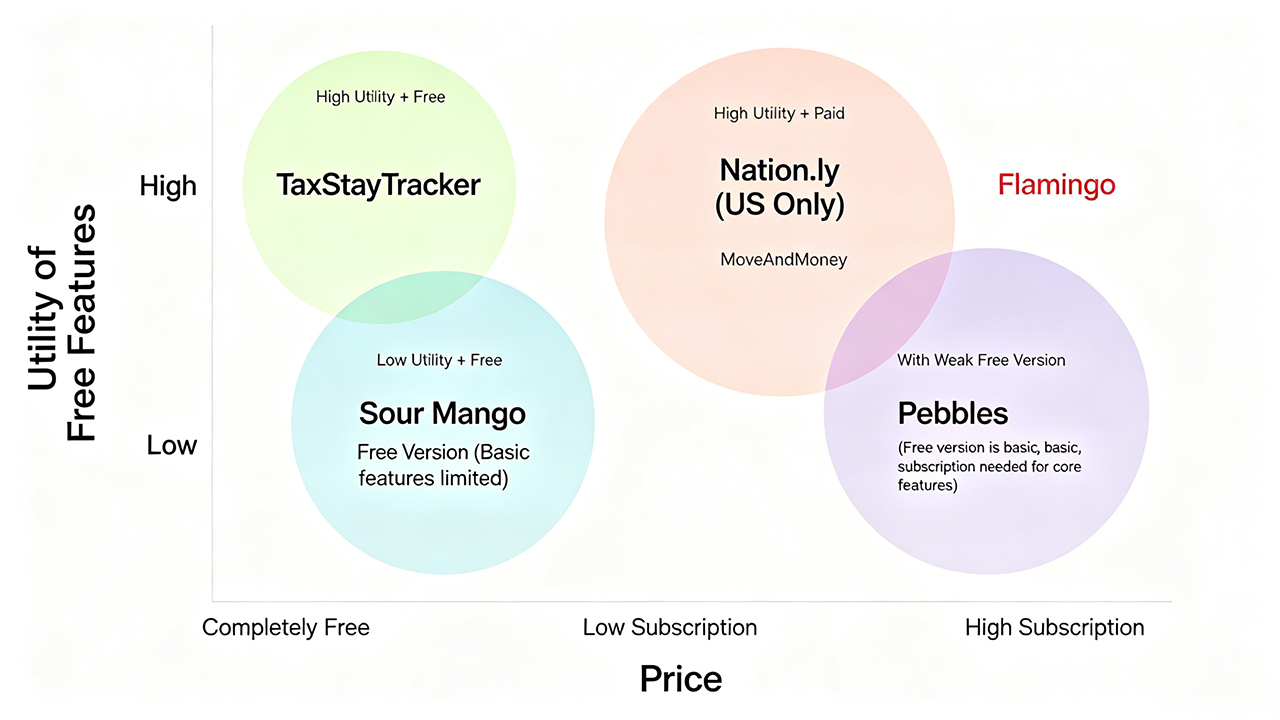
No single app works perfectly for every digital nomad because visa obligations, tax residency exposure, and reporting requirements vary dramatically depending on citizenship, travel style, and income structure. After extensive testing, however, several clear strengths emerged.
For U.S. expats dealing with IRS Form 2555 and Foreign Earned Income Exclusion documentation, Nation.ly stands out as the strongest option. No competing platform currently automates FEIE-related tracking and reporting with the same level of refinement. User feedback consistently highlights how much easier the app makes long-term location tracking for tax filing purposes.
For privacy-focused nomads tracking 183-day tax residency thresholds across multiple jurisdictions, Pebbles remains the standout choice. The platform avoids GPS permissions entirely, stores data locally, and concentrates specifically on the residency and visa metrics that matter most for compliance.
For digital nomads requiring broader compliance coverage—including Schengen tracking, international tax residency calculations, city-level monitoring, and integrated visa lookups—Flamingo Compliance emerged as one of the most powerful platforms tested in 2026. Its May 2026 Schengen update arrived precisely as Europe tightened digital border enforcement, and the app’s predictive “what-if” trip simulations proved especially valuable for long-term international planning.
For casual nomads seeking quick visa guidance without committing to a large ecosystem of compliance tools, Sour Mango on mobile provides one of the most accessible entry points. Its cross-platform availability also makes it convenient for travelers switching between iPhone and Android devices.
For travelers wanting automatic day tracking without paying subscription fees, TaxStayTracker remains one of the strongest free options available. Automatic border detection removes much of the manual logging burden, while the platform’s privacy-focused data policy stands out in a category where extensive user tracking is increasingly common. For iPhone users seeking straightforward 183-day calculations without recurring costs, it remains one of the best free tools currently available.
Regardless of which platform digital nomads choose, these apps function primarily as organizational and tracking tools rather than providers of legal or tax advice. Immigration regulations, residency thresholds, and tax rules change frequently, and outcomes ultimately depend on individual circumstances. The strongest approach remains using these apps to maintain accurate records and trip planning while relying on qualified legal or tax professionals for final filing and residency decisions.