

The ukulele has a reputation for being the “easy” instrument. A week or two in, most beginners hit the same wall. You’re sitting on the couch with a YouTube tutorial paused every ten seconds, strumming the same chord progression over and over while something sounds… wrong. Maybe your fingers are muting a string without realizing it. Maybe your timing drifts every time you switch chords. Maybe that “C chord” you think you’re playing isn’t fully ringing out at all.
The frustrating part? Videos can’t hear you. They keep moving whether you’re playing perfectly or building bad habits in real time.
That’s exactly why a new generation of music apps has become so popular. Instead of acting like passive tutorials, these apps actually listen through your phone’s microphone while you play. Hit the right chord cleanly? You’ll know immediately. Miss the rhythm? The app catches it. Some even pause lessons until your fingers land in the correct position. After testing the biggest ukulele learning apps across different room conditions, skill levels, and practice styles, a few clearly stood above the rest.

Yousician is relentless — and that’s exactly why it works.
The app turns practice into something that feels halfway between a lesson and a rhythm game. Colored notes scroll across the screen while the app listens to your ukulele in real time through your phone’s mic. Nail the note? Green. Miss the chord? Red. Play late? The app lets you know instantly.
And if you completely botch a section, it doesn’t politely ignore it and move on.
It stops you.
That little feature changes everything because it prevents the classic beginner mistake of rushing through songs while quietly reinforcing sloppy timing and weak chord transitions. You can’t really “fake” progress here. The app forces your fingers and rhythm to improve together.
The pitch recognition is surprisingly sharp too. Even with nylon strings — which can sometimes sound muddy on cheaper instruments — Yousician usually identifies exactly which string or note went wrong.
The downside is the pricing. The free version feels more like a demo than a full learning experience, giving you only short daily sessions before locking most lessons behind a subscription. It also burns through battery life pretty quickly since the app constantly processes live audio while running animated lesson tracks.
Still, if you want fast feedback and structured progression, this is probably the strongest all-around learning platform on mobile.
Excellent real-time note and chord detection
Lessons pause until you play sections correctly
Structured learning paths from beginner to advanced techniques
Highly engaging game-style interface
Expensive subscription model
Heavy battery drain during long practice sessions
Not everyone learning ukulele wants to study music theory or practice scales for an hour.
Some people just want to strum along to songs they already love. Kala understands that better than most apps.
Instead of obsessing over individual notes and tablature precision, Kala focuses heavily on rhythm, chord timing, and smooth transitions. The app listens for overall chord shapes rather than isolated single-note picking, which makes the learning curve feel much less intimidating for beginners.
The karaoke-style setup works especially well. Chords move across the screen alongside full backing tracks, and the app scores your performance after each song. Miss a transition? Rush the rhythm? It points out exactly where things started falling apart.
Practicing with actual instrumentation instead of a sterile metronome also makes sessions feel more musical and less like homework.
Kala’s song library is massive too — thousands of recognizable pop and rock tracks sorted by genre and difficulty. If your motivation depends on learning real songs quickly, that matters.
Where the app falls short is fingerstyle playing. Since the listening engine mainly focuses on chord recognition, it’s far less useful for players who want detailed feedback on intricate picking patterns or melodic solos. It’s also pretty sensitive to tuning drift, so if your ukulele slips slightly out of tune, the accuracy drops fast.
Great for rhythm and chord-transition practice
Huge library of recognizable songs
Fun backing tracks that make practice feel alive
Beginner-friendly interface without overwhelming theory
Weak feedback for fingerpicking and tablature work
Accuracy drops noticeably when tuning slips
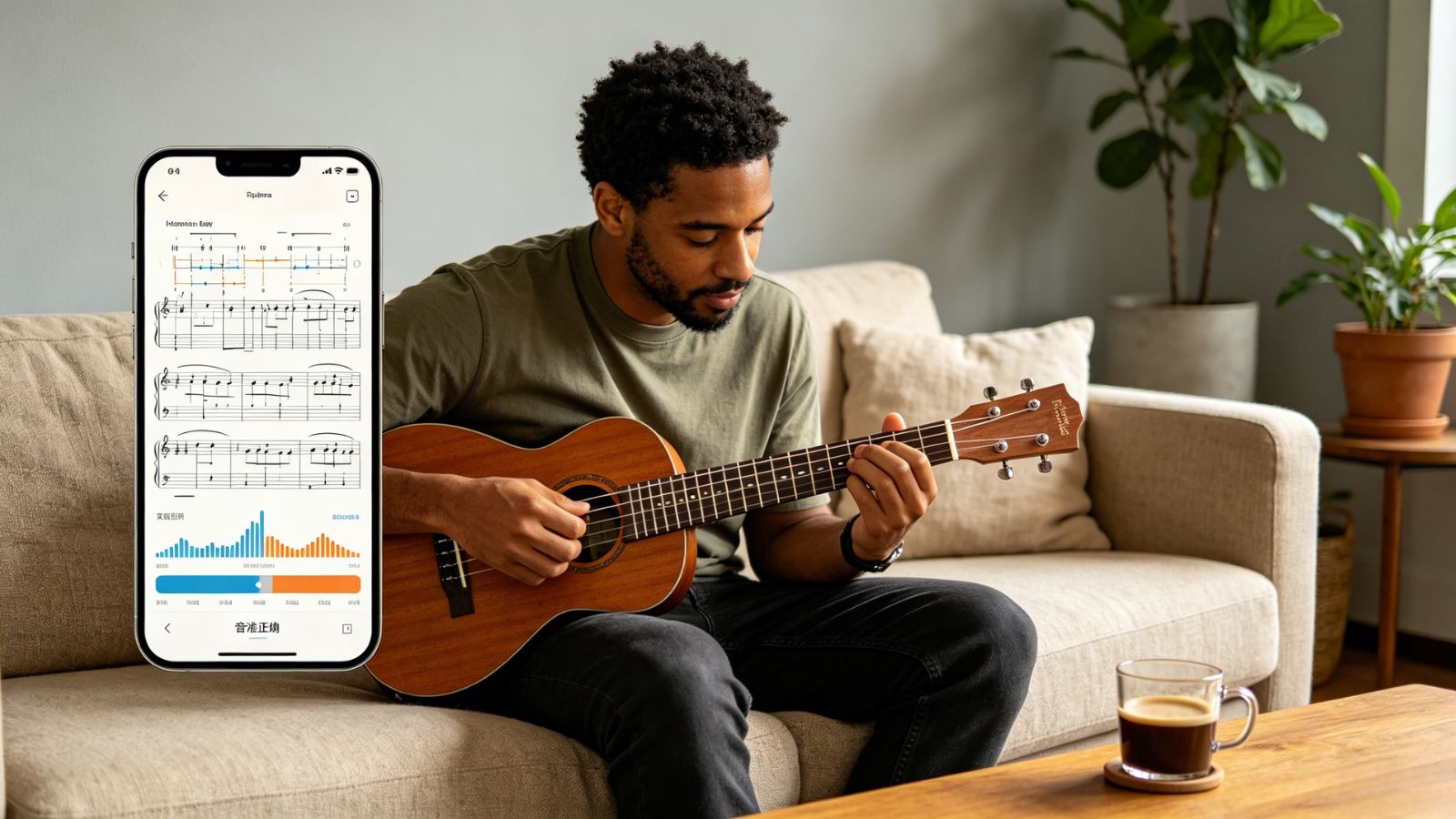
Tunefor doesn’t look flashy. No giant animations. No gamified fireworks exploding across the screen every time you hit a chord.
Honestly, it feels refreshingly focused.
At first glance, it looks like a simple tuner app. Hidden underneath, though, are surprisingly effective training modes that actively listen while you practice. One of the best is Note Pass mode, where the app waits for you to correctly play a note or chord before allowing you to move forward.
That sounds basic. In practice, it’s incredibly useful.
You can slow down completely, focus on finger placement, adjust pressure, clean up buzzing strings, and train your hands without feeling rushed by backing tracks or flashy lesson pacing. The app basically rewards precision over speed.
There’s also a solid ear-training component built in. The app plays notes, asks you to reproduce them by ear, then verifies your accuracy through the microphone. For beginners trying to develop musical instinct instead of pure muscle memory, that’s a huge plus.
The biggest limitation is obvious: it’s iOS-only. And visually, the app feels more functional than modern. If you’re expecting polished graphics and cinematic lessons, this isn’t that experience.
But for focused practice? It’s quietly excellent.
Strong finger-placement and accuracy training
Useful built-in ear training exercises
Lifetime purchase option instead of subscriptions
Great for slow, focused practice sessions
No Android version
Interface feels dated compared to bigger apps
It depends on how you learn.
If you stay motivated through structure, instant correction, and game-like progression, Yousician Ukulele is easily the strongest option. Its feedback loop is fast, strict, and surprisingly effective at fixing mistakes before they become permanent habits.
If your goal is simpler — learn songs, improve rhythm, have fun playing along with music — Kala Ukulele App feels much more relaxed and approachable.
And if you prefer quiet, focused repetition without subscriptions constantly hovering over you, Tunefor Ukulele Tuner and Chords deserves way more attention than it gets.
Either way, the biggest upgrade isn’t the app itself. It’s finally getting real feedback while you practice instead of wondering, “Does this actually sound right?”