

Forget expensive campgrounds. Here are the apps that actually work.
The sun’s setting, the gas tank’s getting low, and the nearest KOA is booked solid—or priced like a mid-range hotel. For anyone who’s ever white-knuckled it through the last hour of daylight, desperately scanning for a rest area or a Walmart lot that won’t get you the 2 AM knock, this scenario is all too familiar.
Between 2024 and 2025, RV shipment volumes hit their highest sustained levels in decades, meaning more rigs are competing for the same finite parking spots, rest areas, and campgrounds than ever before. Free overnight parking isn’t just a nice-to-have anymore; for many budget-conscious road-trippers, it’s the difference between a three-month adventure and a week-long trip cut short by lodging costs.
To find out which apps actually deliver in 2026, we took to the highways and byways, testing each app for three core criteria: database accuracy (are the spots actually free and legal?), safety signals (does the app help you avoid sketchy situations?), and usability (can you find a spot in under two minutes when your co-pilot is hangry?). Here’s what we found.
Why “Free” Doesn’t Always Mean “Safe” – And How These Apps Fix That
Before diving into the apps, a quick reality check. Free overnight parking falls into several categories: BLM land (Bureau of Land Management), National Forest dispersed camping, Walmart and Cracker Barrel lots, casino lots, highway rest areas, and municipal street parking with varying local ordinances. The catch? Policies change constantly, and not all free spots are created equal. A rural highway pullout might offer stunning starlight—and zero cell signal if something goes wrong.
The best apps don’t just tell you where to park. They give you recency checks (reviews from last month, not 2018), safety ratings from fellow travelers, and in some cases, cell coverage overlays so you know whether you can stream Netflix or just cry silently in the dark.
Free tier: Yes | Premium tier: Park4night+ for £9.99/year
When tested, Park4Night immediately demonstrated why nearly 9 million travelers have downloaded it. The database is enormous—over 370,000 locations worldwide spanning more than 100 countries. But raw numbers only tell part of the story. What makes Park4Night genuinely useful is the quality of its community reviews.
A typical listing for a free overnight spot often includes recent photos, noise-level ratings, notes on road conditions, and—most importantly—timestamps on every review. During testing near Moab, Utah, one recently reviewed location included an update from two weeks earlier noting that the road remained passable for standard vans but unsuitable for larger Class A rigs. That level of current information proved extremely valuable.
The Reality Check
Park4Night originated in Europe and still performs strongest there, though its U.S. presence continues expanding rapidly. At the 2026 Florida RV SuperShow, the company showcased the platform and highlighted ongoing investment in the North American market. For travelers planning cross-country U.S. routes, coverage is increasingly solid, though it still lacks the density of some domestic competitors.
Pros:
Enormous global database with more than 370,000 user-submitted locations
Active international community provides near real-time updates on campsite conditions
Free tier remains genuinely useful without feeling heavily restricted
Park4night+ adds offline maps (£9.99/year) and advanced filtering tools
Cons:
Some users report technical issues; testing revealed occasional map-loading lag on older iPhones
Trustpilot ratings remain relatively weak, with recurring complaints about login problems and customer support responsiveness
U.S. coverage, while improving, still trails the platform’s stronger European network
When It Works Best
Park4Night works best for road-trippers crossing international borders or traveling through regions like the American Southwest and West Coast, where its U.S. coverage is currently strongest. The platform excels at surfacing boondocking spots and quiet rural overnight locations that rarely appear in traditional commercial campground directories.
Free tier: Yes (basic) | Paid tier: Pro subscriptions from $8.99/month to $94.99 for Unlimited
iOverlander has earned its cult following for a simple reason: the platform was built by overlanders for overlanders, and that philosophy shapes nearly every part of the experience. The app operates on the belief that no algorithm can fully replace the firsthand knowledge of travelers who camped at a location only days earlier.
The Reality Check
iOverlander is not a polished, corporate-style app. The interface feels utilitarian and somewhat dated, resembling early-2010s navigation software more than a modern travel platform. But what it lacks in visual refinement, it compensates for with practicality and depth of information.
Every campsite entry in the database is submitted by another traveler and typically includes GPS coordinates, photos, road-condition notes, and camping details. Entries are moderated by experienced overlanders rather than automated systems, helping filter out sponsored content and unreliable information.
Where iOverlander truly stands apart is offline reliability. Much of the app’s data is stored locally on the device, allowing travelers deep in remote areas—such as Wyoming backcountry roads or isolated desert routes—to continue accessing campsite coordinates and notes even without cellular service. Offline maps are included with Pro subscriptions, though the free version still retains basic GPS functionality.
Pros:
Core functionality remains completely free without requiring a subscription
Locally stored data allows continued use without cell coverage
Community moderation keeps listings relatively unbiased and free from sponsored clutter
Coverage extends beyond campsites to include mechanics, propane fills, water stations, laundromats, and border crossings
Cons:
The interface feels dated and requires some adjustment
Offline map support requires a Pro subscription starting at $8.99/month
Extremely remote locations may lack reliable access or recent updates, making review timestamps important to check beforehand
When It Works Best
iOverlander works best for travelers leaving the interstate system behind—particularly those relying on dispersed camping in National Forests, BLM land across the desert Southwest, or isolated backcountry routes where “amenities” may amount to little more than a legal flat place to park overnight.
Free tier: Yes | Pro tier: $35.99/year
The Dyrt is the most polished app in this roundup and the only platform here that combines campground discovery with free dispersed camping information inside a single, highly user-friendly interface. Backed by millions of reviews and photos from an active camping community, the app often feels like a camping-focused version of Yelp—though considerably more practical for trip planning.
The Reality Check
The free version performs well for browsing established campgrounds and filtering results by rating, campground type, and distance. However, the platform’s most valuable tools sit behind the Pro subscription ($35.99/year). The standout feature is its layered mapping system, which allows users to overlay BLM and U.S. Forest Service land boundaries to quickly identify areas where dispersed camping is legally permitted. The Dyrt Pro also unlocks access to a database containing more than 16,000 free dispersed camping and overnight parking locations.
Another major advantage is the app’s carrier-specific cell signal reporting. Campers regularly log whether AT&T, Verizon, or T-Mobile service worked at individual campsites. For remote workers and digital nomads who require reliable connectivity before continuing a road trip, the feature proves especially valuable.
Pros:
Sleek, intuitive interface that feels modern and easy to navigate
More than 50,000 campgrounds mapped, plus 16,000+ dispersed camping locations with Pro access
Dyrt Alerts notify users when previously sold-out campgrounds become available
No commission fees attached to Instant Bookable properties
Cons:
The free tier is somewhat limited, with many advanced features locked behind the Pro subscription
Some users have raised safety concerns, and third-party safety ratings remain relatively average
Several road-trip planning tools require paid Pro access
When It Works Best
The Dyrt works best for travelers who prefer researching routes and campsites thoroughly before departure. Its detailed filtering tools, map overlays, and campground database make it particularly effective for planners building multi-stop itineraries in advance. The app also pairs well with more field-oriented platforms used for real-time campsite verification while already on the road.
Free tier: Yes | Pro tier: $35.99/year
A quick browse through experienced RV forums reveals a consistent pattern: RVParky has earned its reputation as a community favorite through reliability rather than flashy features. The app avoids AI-powered gimmicks and instead functions like a well-organized digital road atlas refined by thousands of travelers over time.
The Reality Check
RVParky’s greatest strength is its overnight parking filter. Users can search for locations such as Walmart, Cracker Barrel, casinos, or rest areas, while the app relies on recent community check-ins and reviews to identify which specific locations remain RV-friendly. Because local ordinances change frequently and individual store policies can shift without notice, that constantly updated community feedback becomes extremely valuable.
During testing near Flagstaff, Arizona, a Cracker Barrel location included a user review posted only three days earlier noting that the site was “big rig friendly,” quiet, and well-lit for overnight parking. That level of recent detail transforms overnight parking from a gamble into a much more predictable stop.
Beyond overnight “lot docking,” RVParky functions as a broad trip-planning platform. The app covers full-hookup RV parks, dispersed camping areas, dump stations, propane refills, weather forecasts, and route-planning tools inside a single interface.
Pros:
Completely free with no subscriptions, ads, or paywalls
Excellent database for overnight “lot docking” at retailers and casinos
Includes useful planning tools such as weather forecasts, trip routing, propane locators, and dump station finders
Community-driven updates help keep overnight parking information current
Cons:
The interface feels functional rather than modern or visually polished
Coverage can become sparse in remote regions with fewer active contributors
No native offline map functionality, requiring users to save or screenshot information before entering dead zones
When It Works Best
RVParky works especially well at the end of long driving days when travelers need a quick and reliable overnight backup plan. The app rapidly surfaces nearby legal and community-verified overnight parking options, making it particularly useful for RV travelers seeking flexible stopovers close to highways and major road corridors.
Pricing: $9.99/month or $34.99/year (3-day free trial available)
For many longtime RV travelers, AllStays was once remembered as the classic one-time-purchase road-trip app that lived permanently on a phone or tablet dashboard. After changing ownership in 2022, the platform returned with a subscription-based model and underwent a major overhaul in October 2025, fixing long-standing map and filtering issues while—most importantly—bringing back full Android support. In a category where apps frequently disappear or stagnate, that relaunch signaled something important: AllStays remains very much alive in 2026.
The Reality Check
The reason AllStays continues earning recommendations is straightforward: the sheer volume of information it provides. The platform is built around an “all-in-one” philosophy, combining more than 60,000 points of interest into a single interface. Commercial RV parks, dispersed camping areas on federal land, Walmart and Cracker Barrel overnight parking locations, dump stations, propane refills, rest stops, and roadside services all appear within the same ecosystem.
For travelers trying to quickly assess overnight options during long driving days, that density of information becomes incredibly useful. During testing, searches around major highway corridors consistently surfaced multiple backup overnight parking choices within minutes.
AllStays also functions as a powerful contingency-planning tool. When one Walmart location unexpectedly prohibited overnight parking, nearby alternatives—including a still-RV-friendly Cracker Barrel—were immediately visible inside the app. That kind of rapid backup planning can make a significant difference late in the evening when reliable overnight parking becomes urgent.
Another standout feature is the built-in low-clearance warning system. The app alerts RV drivers and owners of larger rigs about height restrictions and low bridges along planned routes, helping avoid costly or dangerous navigation mistakes.
Pros:
Massive database containing more than 60,000 travel-related points of interest
Excellent all-in-one trip-planning functionality covering camping, overnight parking, propane, dump stations, and roadside services
Built-in low-clearance bridge warnings are particularly valuable for larger RVs and campers
Android support officially returned after the major 2025 relaunch
Cons:
The only app in this roundup without a permanently free tier; full functionality requires a paid subscription
Community review activity is lighter than platforms such as iOverlander or The Dyrt
The interface can feel visually crowded due to the sheer amount of map information displayed simultaneously
When It Works Best
AllStays is less about discovering a hidden scenic campsite and more about building a complete situational overview for life on the road. The app works best before departure or during long-haul driving days when travelers need to compare overnight parking, fuel stops, dump stations, and backup options all at once. For RV travelers willing to pay for convenience and comprehensive information density, AllStays remains one of the most reliable road-trip planning encyclopedias available.
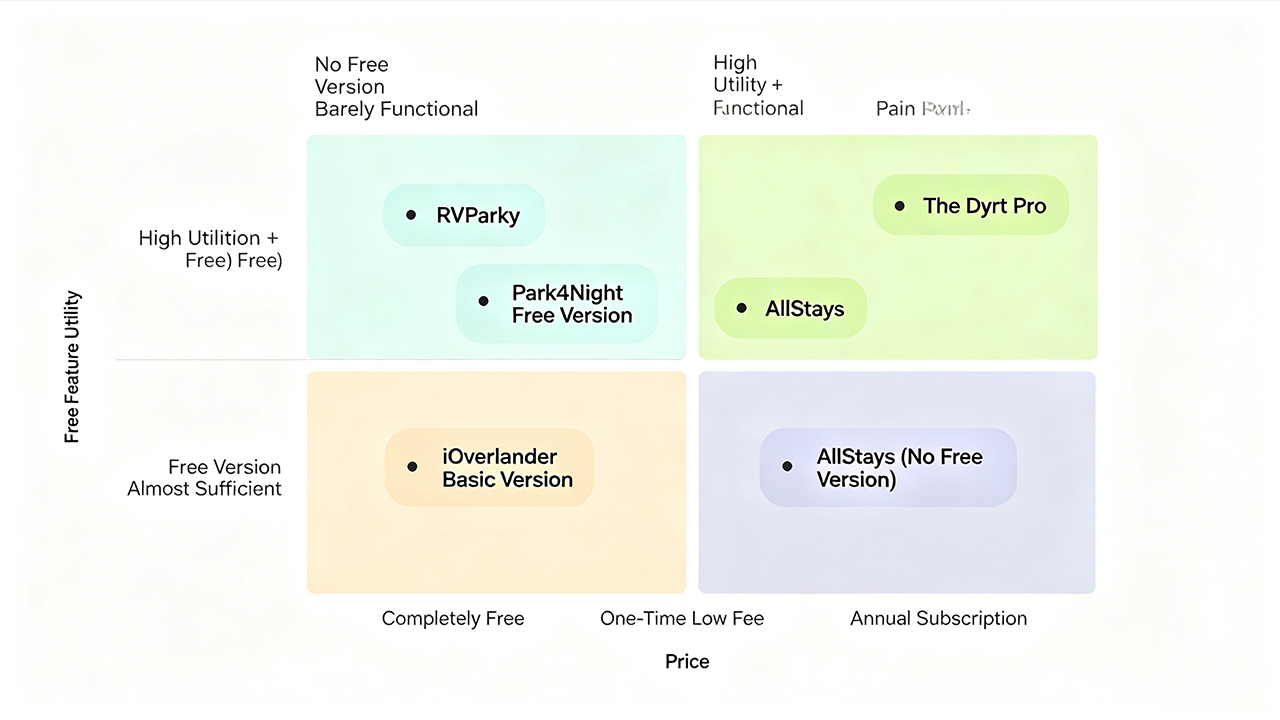
The honest answer is that no single app perfectly handles every camping or road-trip scenario. Different platforms excel in different situations, and experienced RV travelers often rely on several simultaneously rather than committing to only one.
For international travel or cross-country U.S. road trips, Park4Night remains one of the strongest starting points. Its database of more than 370,000 locations combined with a highly active global community provides exceptionally broad coverage, while the free tier remains genuinely functional without heavy restrictions.
For remote off-grid travel and backcountry exploration, iOverlander stands out as the essential choice. Its offline-first structure and traveler-moderated data make it particularly reliable in areas where cellular service disappears entirely.
For travelers who prefer extensive planning before departure, The Dyrt Pro justifies its annual subscription cost for anyone taking multiple camping trips each year. The BLM and U.S. Forest Service overlays, combined with campground availability alerts, significantly streamline route research and campsite planning.
For travelers who frequently rely on overnight parking at retailers, casinos, rest areas, and highway stopovers, RVParky remains one of the most practical tools available. Its community-driven “lot docking” database is especially useful at the end of long driving days, when quickly locating safe and RV-friendly overnight parking becomes the priority. The completely free pricing model also makes it an easy recommendation for budget-conscious travelers.
For RV travelers who want the most comprehensive all-in-one planning tool, AllStays Camp & RV stands out for the sheer depth of its database. The app combines campgrounds, overnight parking, dump stations, propane refills, roadside services, and low-clearance bridge warnings into a single platform. While the subscription pricing is higher than some competitors, the density of information makes it particularly valuable for long-distance RV travelers building complex routes and backup plans.

One Final Piece of Advice
No app fully replaces common sense or on-the-ground judgment. Experienced travelers still rely on backup plans, recent reviews, weather awareness, and personal instincts when evaluating overnight locations. Even highly rated campsites may not feel safe or appropriate under real-world conditions.
Ultimately, the appeal of these apps lies in the freedom and flexibility they provide. With a few reliable tools installed beforehand, travelers can spend less time worrying about where to stop for the night and more time enjoying the road itself.